Why is my roof leaking around the chimney
A roof leak around the chimney is almost never the chimney. It is the flashing — and in Houston, clay-soil movement, wind-driven rain and low-slope edges are what open it up.
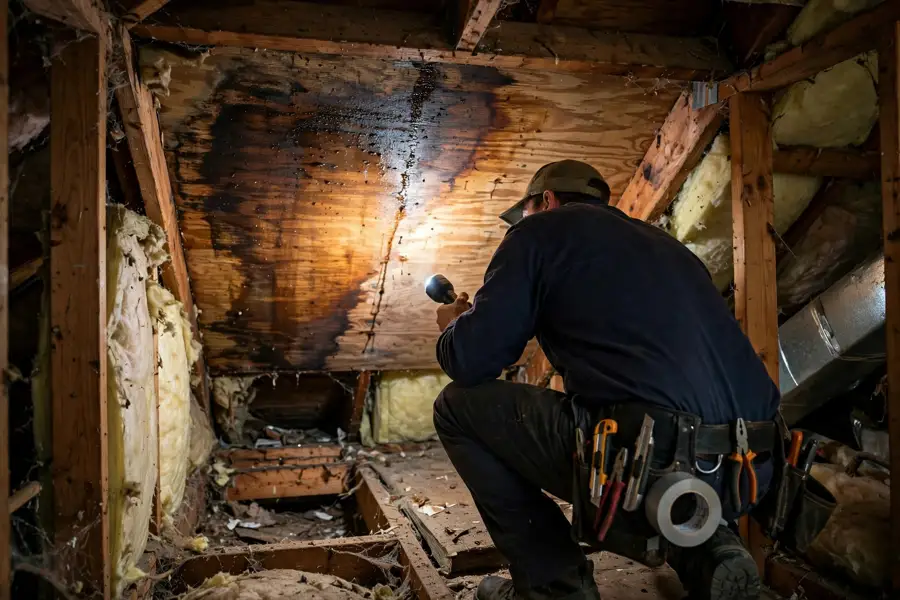
A leak around the chimney is almost never the chimney. It is the flashing — the step flashing woven into the shingles, the counter-flashing set into the masonry, and, where the chimney is wide enough, the cricket that splits water around it. When any of those fail, water gets under the shingles and shows up as a stain on the ceiling below, often feet from the chimney itself. This post explains the mechanism, the Houston causes, and what a proper repair covers.
Flashing, not chimney — and not masonry
Step flashing is a series of L-shaped pieces, one per shingle course, that shed water down the roof past the chimney. Counter-flashing is set into the mortar joint and folded down over the step flashing. If the counter-flashing pulls out of the joint, if a step piece is missing or nailed through its face, or if sealant was used as a substitute for flashing, water gets in. Sealant is not flashing: it fails, and when it does the leak returns. A proper repair replaces the flashing system, not the sealant. One Houston contractor puts wall and chimney flashing repair at $1,200–$1,500 — a single-contractor figure, not a market range — and it is the only sourced chimney-flashing number we publish.
The Houston causes: clay, wind and low slope
Three Houston conditions open chimney flashing up. First, expansive clay soil: in Spring Branch, soil shrinks in drought and swells in rain, stressing foundations and, indirectly, roof flashing and chimney joints. Second, wind-driven rain: in Meyerland, wind-driven rain under a low-slope shingle edge is a distinctive failure, and the same mechanism drives water past chimney flashing on a low-pitch roof. Third, age and material: River Oaks has multiple masonry-chimney penetrations with decorative copper and lead-coated copper flashing at dormers and chimneys, and that flashing is a failure point on 90-year-old systems. A chimney leak on a 25-year-old roof is often the flashing’s age, not the storm’s strength.
What an inspection covers
A roof leak repair inspection at a chimney checks the step flashing course by course, the counter-flashing seating in the mortar joint, the cricket if one exists, the deck around the chimney for soft spots, and the stain path inside. The report should name the failed component — not just “the chimney leaks” — and say whether the fix is flashing only or flashing plus decking. If the leak is active water coming in now, that is an emergency roof repair. For the neighbourhood versions of this problem, see our River Oaks, Heights and Spring Branch pages, and for the repair itself, roof repair.
Get help with a chimney leak
Leak around the chimney? A leak around the chimney is a flashing job, not a chimney job. Call (346) 654-5170 and we will check the flashing and the low-slope edges. We will inspect the flashing and the deck around it, and give you a written scope.