How to tell if your roof has hail damage in Houston
Hail in Houston can bruise shingles without breaking them. Here is how to spot the damage from the ground, document it, and know when to call a roofer.
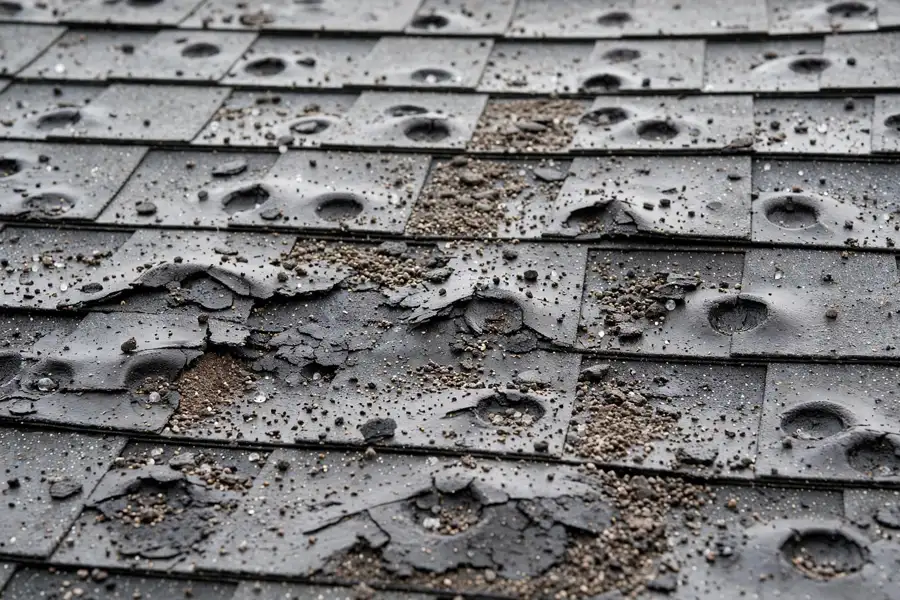
Hail season in Houston is spring, peaking in May, and about 94% of very large hail in Texas falls between March and June. The damage it does is quiet: hail bruises shingles without breaking them, cracks flat membranes without leaking for months, and dents the soft metal that proves it happened. This post covers what to look for, what it means, and why the real check happens on the roof surface — not from the driveway.
What hail does to a shingle
Functional shingle damage generally starts at about 1-inch hail — quarter-size — or a 58 mph gust. The hail knocks granules off, bruises the shingle, and in worse cases fractures the mat underneath. From the ground, a bruised shingle can look intact. From the roof surface, the bruise is soft underfoot, the granule loss is visible, and the crater is obvious. That is why hail damage is assessed from the roof, slope by slope, and why “I looked from the yard and it looks fine” is not an inspection. Houston shingles last roughly 18–25 years in heat, UV and humidity, so the inspector also separates hail damage from age — granule loss on a 22-year-old roof is not automatically a hail claim.
The soft-metal tells
Before anyone climbs a ladder, check the soft metal: dented gutters and downspouts, dented vent caps and flashing, and dented air-conditioning fins. Soft metal dents at hail sizes that bruise shingles, so it is the ground-level evidence that hail fell hard enough to matter. Also look for granules piled in gutters and at downspout outlets, and shingle pieces on the ground. Photograph all of it, with the storm date noted — it is the documentation your insurer will want.
Functional versus cosmetic — the distinction that decides claims
Not all hail marks are damage. Cosmetic marks change how a shingle looks; functional damage changes how it performs — granule loss that exposes the mat, bruises that crack it, fractures that let water in. Only functional damage supports a claim, and only an inspection from the roof surface can tell the difference. Class 4 shingles are hail-resistant, never proof against hail, and there is no Houston hail or Class 4 mandate — any contractor who tells you the code requires them is selling, not informing.
When to call, and what happens next
Call for a roof inspection after any hail event that dented soft metal or left granules in the gutters — and book a pre-season inspection in February or March, before hail season peaks. The inspection photographs every slope and produces a written scope. If the damage is functional, the next step is a hail damage scope and, if you claim, our roof insurance claims hub explains ACV versus RCV and the deductible law. For the Cypress “Hail Alley” question, see our Cypress page — and for the shingle itself, our shingle roofing page.
Get help with hail damage
Hail damage to check? Think your roof took hail? Call (346) 654-5170 — we check granule loss and bruising on the roof surface, with photos for your insurer. We will inspect, photograph what we find, and give you a written scope with the photos your insurer will ask for.